
Doubling Back (again) – guest post by Linda Cracknell
Posted on June 6, 2024
Having a book reissued ten years on from first publication has proved to be an interesting opportunity for reflection. The ways charted in Doubling Back: Paths Trodden in Memory, first published in 2014, were walked between 2007 and 2012. The exception to this is the Norwegian route, completed in 2004, which first made me realise the emotional value of walking in others’ footsteps, and that such paths may be covert and unmarked. As this one retraced a wartime escape story, it was particularly dramatic; it would come to inspire a whole project.
Now in 2024, I come face to face with these various written portraits of landscape and my younger self. Rereading them feels archaeological and layered. In the first essay, ‘The Opening Door’, I returned to Boscastle, North Cornwall in 2008 to recall my discoveries on foot in 1976, as a mere girl, of Thomas Hardy’s formative time in this place of tinkling valleys and violent cliffs. The passage of time between now and the walking, then writing of these stories is evident. In ‘The Return of Hoof Beats’, I’m reminded of a long walk I took with pack ponies and the two young girls I met along the way, who I now hear about as young adults with their own horses. Public concern today about the serious ablation of the Aletsch Glacier recolours the ‘road’ taken towards my father’s story in ‘Outlasting our Tracks’. The debate around faith groups and global movement of people has not stood still since I wrote ‘Stairway to Heaven?’ about Mozarabic trails in south-eastern Spain.
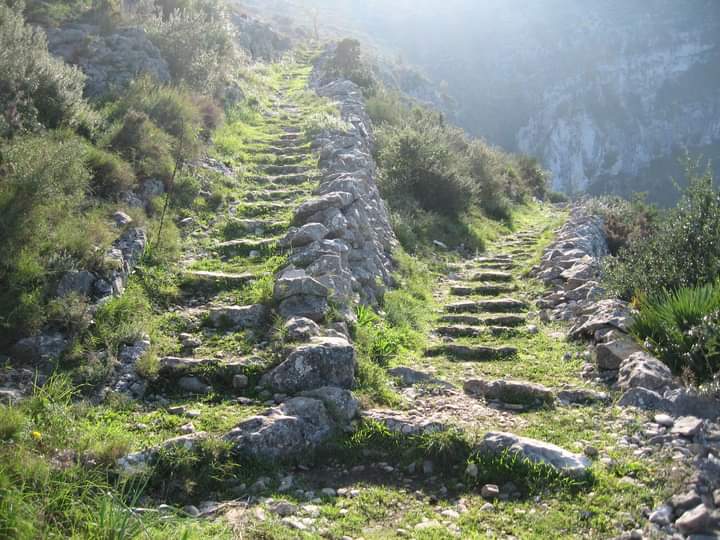
Mozarabic trail in Spain.
These journeys took me to Norway, Kenya and the Swiss Alps, as well as places closer to home. I followed fathers, writers, drovers, saints, but doubt I could now justify all that travel. I am still walking but, though I retain my doggedness and the focus I find in solitude, the walk of 2023 – new to this edition – marks out some changing habits and concerns. In particular, the time gap highlights my recent wish for stillness as well as motion, and the inescapable thoughts of the climate crisis and its interaction with political issues such as land-ownership when I contemplate landscape and nature now. This additional walk takes me to Scotland’s Flow Country, where these issues are stark.
So how did it all start? In 2007 I was the lucky recipient of a major Creative Scotland Award which enabled the project leading to this book. I kept a blog, Walking and Writing, between 2007 and 2012, which reminds me now of some of the background: why I find walking and writing inseparable, what I was reading, reflections on maps and mapmaking, what I did when I was injured and couldn’t walk, work I was doing on the interpretation of the Annandale Way, and being editor of an anthology of writing on nature and landscape, A Wilder Vein.
I had written two collections of short fiction, a novel and some radio drama by then. Despite my intention of making the dialogues between my feet and landscapes into nonfiction, some wanted to find their form in fiction, such as a radio play – The Three Knots – set on Loch Sunart in an 1840s midwinter. A dry-stone dyke I followed demanded a conversation with the walker concerned and the resulting piece of writing was no longer exactly non-fiction. A walk following servants bearing laundry five miles across the island of Rum spawned a story set at the start of the First World War.
Perhaps this happened because I was initially a little uneasy about leaving my fiction ‘home’ in which I could hide behind my characters. In setting out on the Doubling Back project I discussed this on my blog:
‘I love writing fiction. I love the mysterious way that observation and imagination mesh and wrangle to make something that feels complete and true. My characters can often be found moving through wild or semi-wild landscapes, taking some sort of personal meaning from mountains, or going on journeys. And yet they are not me.’
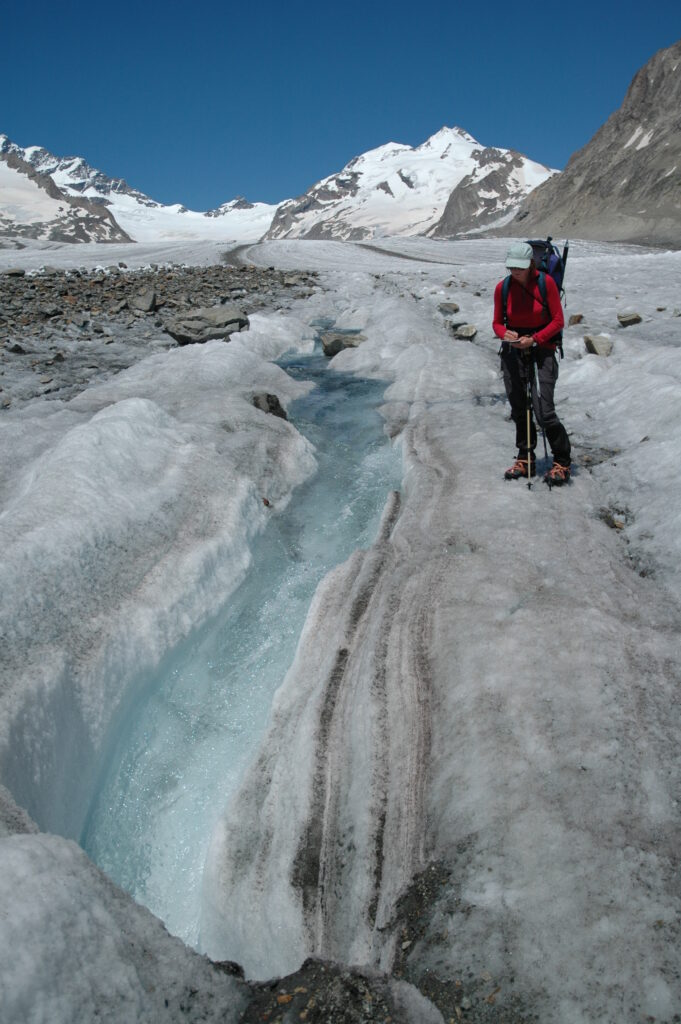
Making notes on the Aletsch Glacier. Photo by Colin Hughes.
Quite naturally, though, the new walks, once written up with me in them, contained elements of memoir, particularly when I crossed the emotional terrain of my long-dead father in the Swiss Alps, or walked in the West Coast landscapes of my ex-partner. I became less afraid of such personal revelation in writing. But it was the time spent structuring disparate essays into a book which delayed its publishing until 2014, and in that process some of the writings had to be dropped.
I also wrote on that blog about abridging Robert Macfarlane’s book, The Wild Places, for BBC Radio. He was still a relatively new name then, and one of the few who I knew were writing along the same lines as myself. We corresponded as our ‘walking’ books developed in parallel, but he clearly had more foresight in structuring his material than I did. The Old Ways: A Journey On Foot came out two years before Doubling Back, helping to establish a new audience for such writing. Not surprisingly his book became a yardstick but, at least according to Roger Cox’s review of Doubling Back in the Scotsman, our books were sufficiently different. It was devastating when my book disappeared with the collapse of Freight Books in 2017.
I also feel the passage of time when in bookshops. It is wonderful to now be able to browse shelves full of nonfiction books focusing on landscape, walking and being in nature that are immensely varied in their approaches and outlooks. In particular, I’ve been gratified by how many women are writing such non-fiction books: Kathleen Jamie, Noreen Masud, Ruth Allen – each with a different emphasis. I’m looking forward to the new and lovely Saraband edition of Doubling Back: Paths Trodden in memory finding its place amongst them in the UK this year, and North America next.
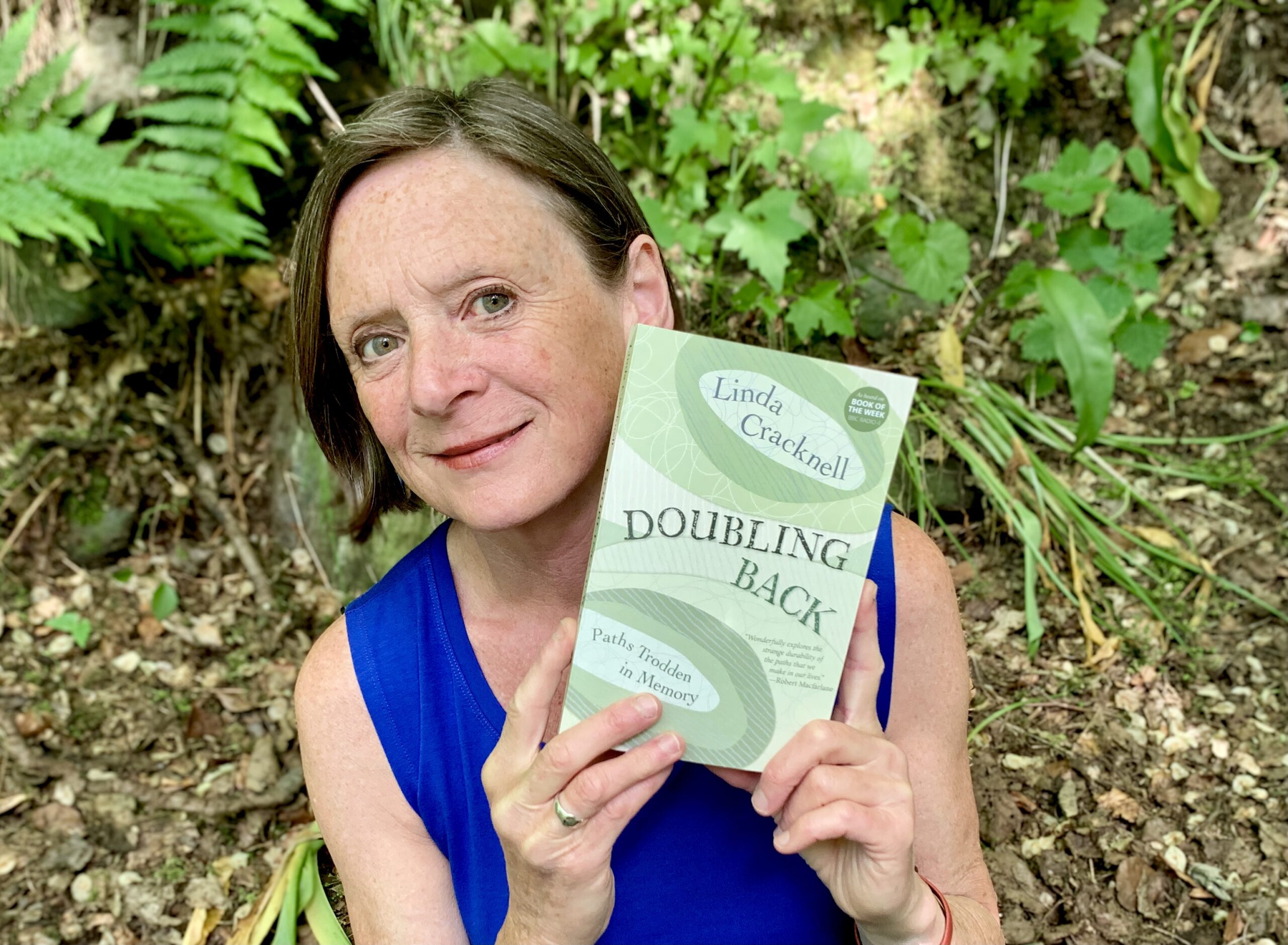
Photo credit Robin Dance.
____________________________________________________________________________________
Linda Cracknell is a writer of narrative non-fiction on the natural world, as well as of fiction and radio scripts. Her first story collection was nominated for a Saltire Award (now Scotland’s National Book Awards) and the Robin Jenkins Award for environmental writing, and her essay collection Doubling Back: Ten Paths Trodden in Memory, about journeys she took on foot in Scotland, Spain, Switzerland, and Kenya, was serialised for BBC Radio as a Book of the Week. All of Linda’s writing is inspired first and foremost by place, and she teaches creative writing, especially nature and place writing.
