
I’m Blue: You’re Yellow – extract from Earthworks by Karen Lloyd
Posted on July 28, 2026
While making wildflower meadows in inner cities feels like – and is – a radical act, the genesis of Everton Park’s meadows is very different: it began its life as an installation by visual artist Rebecca Chesney.
Rebecca and I had met earlier in the year in her studio in Preston when she’d shown me photographs of Everton meadows, which are a square of blue flowers and a square of yellow, titled, I’m Blue: You’re Yellow. The concept for the installation came about during a residency at the Yorkshire Sculpture Park (YSP), where, during her time there, Chesney researched into the colour preferences of pollinators. From her observations, she concluded that pollinators gravitate more towards yellow and blue flowers, and from this she designed two square meadows divided by a narrow path. For reasons to do with Natural England funding for land management schemes at YSP, the meadows could not, after all, be planted, but in an act of timely serendipity, Liverpool offered an alternative.
Rebecca made contact with Richard and Polly, and together they convened a site meeting with the Friends of Everton Park and the city council. Like so many cash- strapped local authorities, the management of Liverpool’s parks had been delegated to newly formed Friends of Parks volunteers. To the local group, Rebecca’s meadows were a dream come true, and with subsequent support from the Liverpool Biennale and Arts Council England, her meadows were given the green light.
As we set off down the narrow path between the two meadows, Richard explained how in the first year, the ground was rotovated (mechanically turned over) and scattered with bucketfuls of annual wildflower seeds, then thousands of perennial species were planted with the team and scores of local volunteers.
‘Doing it like this,’ Richard explained, ‘with seeds and plug plants, meant that the whole thing soon got going. Very quickly, there was loads of colour, mostly corn marigolds in the yellow meadow,’ he said point into the yellow flowers, ‘and cornflowers in the blue.’ The meadows were overflowing with lupin, self-heal, bird’s-foot trefoil, toadflax. In among the flowers, buff-tailed bumblebees harvested pollen from the optimistic yellow of corn marigolds and fronds of viper’s-bugloss. A couple of guys in running gear hammered up and down the narrow path. Richard and I stood aside each time they passed.
‘Once the plants set seed in late summer,’ Richard continued, ‘we mowed the meadows – that helps with seed dispersal – then in the second year, the perennial plants flowered spectacularly.’ The team brought in an ecologist who identified nine species of solitary bees along with hoverflies, sawflies, burnet moths, seven-spot ladybird, small tortoise- shell, small skipper butterflies, meadow browns and more.
Over tea and cake in her studio, Rebecca had talked to me about the vagaries of local people connecting with nature in Everton meadows.
‘You get teenagers tearing through them on motorbikes,’ she said, ‘and someone drove a car into them and set fire to it once; all that kind of inevitable crazy stuff. But people have wedding photographs taken in them, and a local GP is now doing green prescribing using the meadows to help people with anxiety and depression. Families bring picnics, and we have three local primary schools taking groups out to learn about diversity in nature. The teachers ask the kids questions like, “What insects can you see on this short grassy area, and now, how many can you see in the wildflowers?”
‘Before the meadows existed,’ she went on, ‘it was just a lacklustre green space. Now it’s a much-loved part of the city, so much so that locals have been buying and guerrilla planting around the edges, keeping the whole thing moving and growing. These days, the meadows are less hard-edged and more organic.’
What I’m Blue, You’re Yellow confirms is that wildflowers and pollinators are good for humans, even though there are no signs to communicate their value: the meadows and pollinators just are – noted, assimilated, valued and enjoyed – which is a massive win in terms of engaging people with urban nature and green spaces. And in, God forbid, another lockdown, we can be sure where folks from the surrounding communities will head for their daily allowance of the outdoors; the runners, the kids, the families, along with the troublesome teenagers who at least seem to recognise the meadows as a destination worthy of their albeit problematic attention. As Richard had said over lunch back in the café, nature shouldn’t just be something for those with the resources to access it, it has to be much more egalitarian so as to provide an intermission from urbanity for the greatest possible number of people. In Liverpool, through urban wildflower meadows, that idea is writ large.
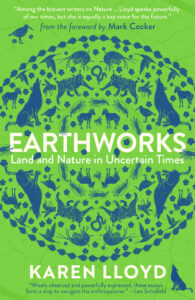 Earthworks: Land and Nature in Uncertain Times by Karen Lloyd
From the rainforests of Costa Rica to the Balkans and Scotland, Karen Lloyd explores the hidden life of habitats and species including sloths, the rockpool shrimp and the world’s only truly wild horse. She studies the biodiversity of urban wildflower meadows and the contested spaces of landscape recovery, including in the Lake District where she lives, assessing our human impact on the lives of creatures whose survival is deeply intertwined with our own.
